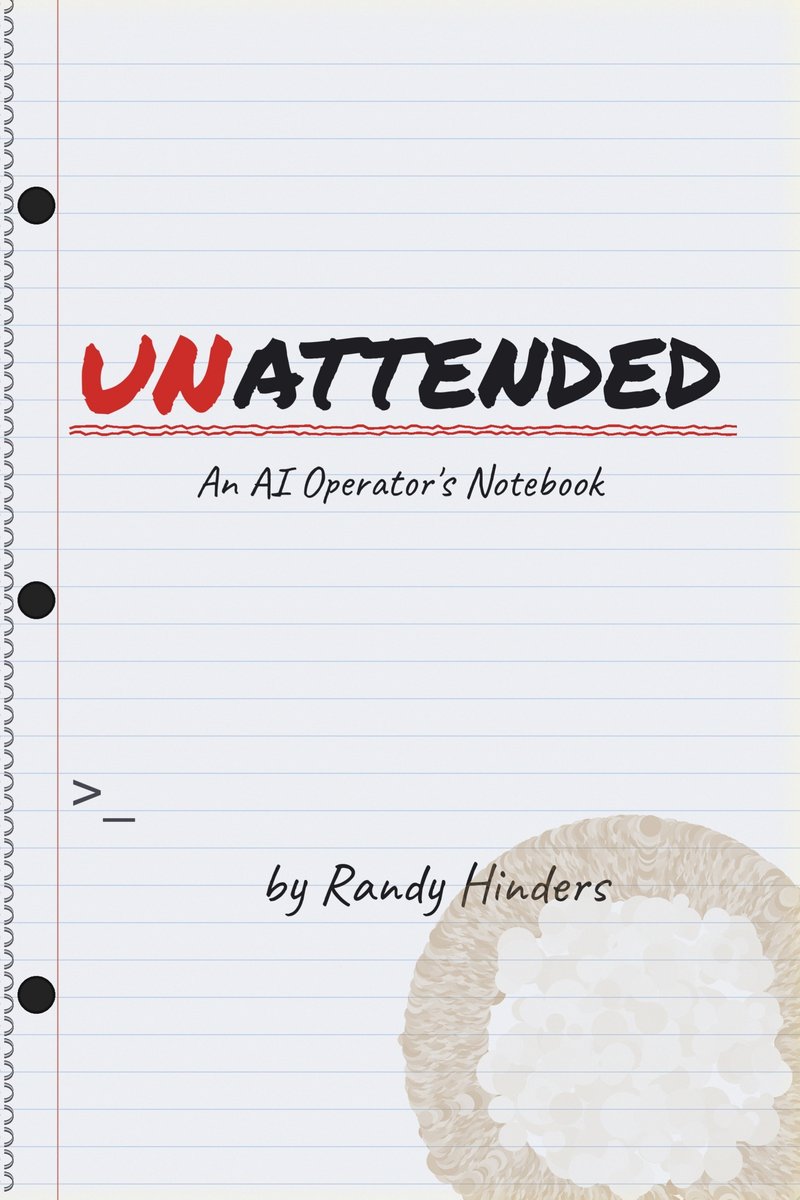
>_ the book
What happens when nobody is watching
What actually happens when you run autonomous AI agents in production and nobody is watching?
No one is babysitting. They are just working. Doing their jobs 24/7/365.
Randy Hinders spent seven months finding out. Starting with a single AI assistant and scaling to a full team of specialized agents handling email, trading, security operations, content publishing, and outreach — all running around the clock, all unsupervised.
This is not a tutorial. It is a field notebook. The mistakes are real, the lessons are hard-won, and nothing has been cleaned up to look smarter than it was.
>_ contents
Inside you will find
- How to build trust with an AI system in stages, not all at once
- What breaks when you give agents real work with real consequences
- The operator skills no certification teaches
- Why the biggest risk is not the AI — it is your own assumptions
>_ who it is for
Written for the person who runs things
Written for IT leaders, business operators, students entering a job market that looks nothing like it did five years ago, and anyone who wants to stop reading about AI and start running it.
The owner
“The small business owner who handles everything because there’s no one else.”
The operations manager
“The operations manager who knows what ‘works in production’ actually means.”
The IT leader
“The IT director who keeps the lights on.”
The student or career changer
“The student or recent grad staring at a job market that doesn’t look like the one I walked into.”
Lines in quotation marks are from the book’s Introduction.
>_ from the pages
Lines from the notebook
You DO NOT need to be a programmer to get value from this book.
Nine times out of ten, the agent did exactly what you said. The gap was between what you said and what you meant.
Never trust ‘done.’ Verify the end state yourself.
The tool that reported success is never the tool that confirms it.
>_ read the opening
From the Introduction
This book wasn’t planned. It started as notes.
In January 2026, I gave an AI agent access to my email, my calendar, and my messaging platforms. Not a chatbot, an autonomous system that could read, write, and act on my behalf without me sitting at the keyboard. I wanted to see what would happen when I stopped treating AI as a tool I picked up and put down and started treating it as something that worked alongside me.
What happened was seven months of the steepest learning curve I’ve had since I got out of the Army and walked into my first IT job. Except this time, nobody had written the manual. There were no best practices I could find, no vendor certifications, no “AI Operator” job title on LinkedIn. Just other people on the bleeding edge, trading notes on social media about what did and didn’t work, a handful of language models, and a growing list of things that went wrong in ways none of us expected.
I wrote it all down. Not because I thought it would become a book, but because I needed to remember what I’d learned before I forgot it. The notes turned into LinkedIn posts. The posts turned into a book.
Why this book exists
I’ve been in technology for over thirty years. Web development and the beginning of the internet in the nineties. Enterprise automation. Infrastructure. Security. I’ve watched entire job categories appear, evolve, and disappear. I’m watching it happen again right now.
The tools coming our way aren’t incremental improvements; they are a different way of working. And the people who figure out how to use them, really use them, not just ask a chat LLM to write an email, are going to have an enormous advantage over the people who wait for someone to hand them a training manual.
That manual doesn’t exist yet. This book is my attempt to start writing it.
What I’m describing in this book isn’t just AI agents. It is something more specific: an AI Orchestration Agent, or AOA. That’s the term I use here for the coordinating agent, the one that runs the others. This book is about how operators, not engineers, can put one to work. A chatbot answers questions. An agent performs tasks. An AOA coordinates across tools, platforms, and other agents, reading email, checking calendars, posting to social media, managing deployments, and handing work off to specialists, all without a human directing every step. That distinction matters, and it is the foundation of everything in this book.
I didn’t write this for AI researchers or machine learning engineers. I wrote it for the person who runs things. The IT director who keeps the lights on. The small business owner who handles everything because there’s no one else. The operations manager who knows what “works in production” actually means.
I also wrote it for the student or recent grad staring at a job market that doesn’t look like the one I walked into. You can understand this method without being a programmer. Running it unattended, in production, still takes technical judgment or someone who has it; I’ll tell you where.
If this book helps someone find a rung on a ladder that keeps changing shape, it was worth writing.
How it got here
This book was written the way I think it should be read: one lesson at a time, grouped by the operating problem rather than strictly by date. Chapters 1 through 3 are the story: how the project started, what I brought to it, and the first real test. Chapters 4 through 10 are the lessons: what broke, what worked, and the principles I extracted from both. Chapter 11 is the blueprint, Chapter 12 is what it takes to run it, and the Afterword is how this book was made. The appendices are reference material: a glossary and a set of starter scripts to get you moving.
Every chapter is based on something that actually happened. I kept the daily logs, the terminal output, the Discord messages, the memory files. Where I made mistakes, and I made plenty, I left them in. You learn more from the failures than from the victories, and I’d rather be useful than impressive.
The agents that run my operation today, Tom, Oscar, Cash, and a handful of others, were all built during the period this book covers. By the end of the book, they are a team. But they started as experiments, and most of the interesting lessons came from the experiments that didn’t go the way I expected.
End of excerpt. Get notified at launch to read the rest.
>_ appendix b
Starter scripts from the book
The heartbeat check, the disk-usage reporter, the disk cleanup, and the security audit that show up in Appendix B, packaged with a README, a crontab example, and sanitization notes. Real IDs, tokens, paths, and hostnames are replaced by placeholders. Read the README before you wire anything to your Discord.
Eight files, about 22 KB, Apache-2.0. Bash and cron. You will need to fill in your own webhook URLs and a Discord bot token. No warranty, no telemetry, no phone-home; read them before you run them.
Prefer git? The same files, at the same version, live at github.com/oscarsixsecllc/unattended-scripts.
>_ launch list
Get notified at launch
Five emails, launch news only.
Signup opens shortly
The launch list is not open yet, so this page is not collecting email addresses. Check back soon.
Your email is used only for book launch news from Randy Hinders and Oscar Six Security. Unsubscribe any time by replying.
>_ formats
Formats and price
>_ reader thank-you
Free scan for readers
You bought the book? Here is a free Radar scan on us.
Every reader who buys Unattended, paperback or Kindle, can redeem one free Radar external-surface scan. No review required. No strings. No upsell email chain. Just our thanks for reading.
Send us proof of purchase (Amazon order confirmation or a photo of your copy) and we will issue one scan credit to your work email. First 200 readers, then we open a waitlist.
Work email required. Personal free-email accounts (Gmail, Hotmail, Outlook, Yahoo, iCloud, AOL, Proton) are not eligible. Scan target domain must match your redemption email domain. Full terms on the redemption page.

>_ about the author
Randy Hinders
Randy Hinders, CISSP, has been in technology for more than thirty years and early to every wave of it: building websites when the internet was new, automating software delivery before anyone called it DevSecOps, running enterprise workflow automation before “digital transformation” had a name, and now operating a team of AI agents from a single machine on his desk.
He is a longtime IT leader, the founder of Oscar Six Security, LLC, and a co-inventor of a patented medical device through RH2 LLC. He is a US Army veteran and a former paratrooper, no longer on jump status. It turns out the habits transfer: check your equipment, trust the plan, and don’t step out the door without knowing how you’re getting back. He is known for shipping software, not slideware.
He lives in Ohio with his wife of twenty years, is a father of three, and travels whenever he can.
Right now he is probably in his basement, talking to machines.
Learn more at randyhinders.com
>_ in person
See Randy speak
“Unattended” at Taste of IT
November 18, 2026
Presented by Technology First at the Sinclair Conference Center, Dayton, Ohio.
Want Randy to speak to your team or event? Send a speaking inquiry.
>_ press
Media kit
Cover art, author headshot, 50, 100 and 200 word bios, sample interview questions, and a one-sheet.